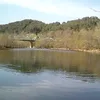
Wikipedia EN Caney Fork
The Caney Fork River is a river that flows through central Tennessee in the United States, draining a substantial portion of the southwestern Cumberland Plateau and southeastern Highland Rim regions. It is a major tributary of the Cumberland River, and is part of the Cumberland, Ohio and Mississippi basins. The river is 143 miles (230 km) long, and its watershed covers 1,771 square miles (4,590 km2) in eleven counties. Monterey, Baxter, Sparta, Smithville, McMinnville, Altamont, Spencer and Gordonsville are among the towns that are at least partially drained by the river.
The Caney Fork flows through two impoundments— Center Hill Lake and Great Falls Lake— both of which create sizeable artificial lakes. The river's basin is home to numerous protected lands and recreational areas, including five state wilderness areas, six interpretive areas, and a wildlife management area. Two state parks— Edgar Evins State Park and Rock Island State Park— are located along the river, and three others— Fall Creek Falls State Park, Burgess Falls State Park and South Cumberland State Park— are located within its basin. The river is a popular stream for canoeing and kayaking.
The name "Caney Fork" comes from the dense cane breaks that grew along the river's banks when European explorers first arrived in the area.
The river is a major drainage feature of the Cumberland Plateau and the largest tributary of the Cumberland River.
Source: Wikipedia https://en.wikipedia.org/wiki/Caney_Fork_River