Delta
129.02 km | 80.17 mi
Länge kann von der offiziellen Messung abweichen!
Kategorie 3
Diesen Fluss auf der eigenen Website einbetten
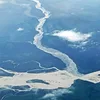
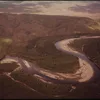
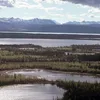
The Delta River (Middle Tanana: Niithaayh Ndiige) is a river in eastern Alaska and a tributary of the Tanana River, and by extension the Yukon. Originating from the Tangle Lakes, the river flows north through the Alaska Range, carving a valley perpendicular to the east-west mountain range. Initially clear and slow-moving, it becomes faster and silty after taking in Eureka Creek, its first major tributary. As it flows through the Alaska Range, it takes in meltwater from various glaciers and glacier-fed streams. At the end of its roughly 80-mile (130 km) course, the river meets the Tanana near the settlements of Big Delta and Delta Junction. The geology of the basin is highly complex, with various glacier-shaped landforms and alluvial deposits from the river. Dust from the river valley is spread by the wind and forms a layer of loess to the west of the river. The river basin is home to various birds, mammals (including caribou), and plants, while the water hosts fish such as northern pike and arctic grayling.
The uppermost portions of the Delta River basin are in the Tangle Lakes Archaeological District, containing over 600 documented archaeological sites, with the earliest occupation attested from over 10,000 years ago. The Upper Tanana Athabaskans and the Ahtna both lived in the basin and hunted around it. In 1885, American army officer Henry Tureman Allen explored the river and named it for its braided water channels. Gold mining and road construction took place in the river valley during the early 1900s, followed by the construction of the Richardson Highway running parallel to the river. Agricultural development projects were made around the river during the 1970s and 1980s, although most of the river basin remains wilderness under the administration of the Bureau of Land Management and the Alaska Department of Natural Resources. A portion of the upper Delta River was designated a National Wild and Scenic River in 1980.
Quelle: Wikipedia
The uppermost portions of the Delta River basin are in the Tangle Lakes Archaeological District, containing over 600 documented archaeological sites, with the earliest occupation attested from over 10,000 years ago. The Upper Tanana Athabaskans and the Ahtna both lived in the basin and hunted around it. In 1885, American army officer Henry Tureman Allen explored the river and named it for its braided water channels. Gold mining and road construction took place in the river valley during the early 1900s, followed by the construction of the Richardson Highway running parallel to the river. Agricultural development projects were made around the river during the 1970s and 1980s, although most of the river basin remains wilderness under the administration of the Bureau of Land Management and the Alaska Department of Natural Resources. A portion of the upper Delta River was designated a National Wild and Scenic River in 1980.
Quelle: Wikipedia